
Ode to Dumplings
Notes on Ulaanbaatar, mandu, and the Asian identity dream
Ulaanbaatar surprised me. I’d heard about the Soviet buildings, could imagine how young people animated the streets, but I wasn’t expecting the kind of mercurial weather that happens right on top of you. Blunt August sun, downpours and frigid gusts, darkness drawing in fast. There was a strange pleasure in the unpredictability, though, especially when you found the right remedy.
One evening, bitter breeze slapping skin, K and I bundled into a restaurant inside a Buddhist temple. It was instant warmth: hands beckoning, low lighting, steam drifting from the open door of the kitchen. On the server’s recommendation, we ordered two types of handmade dumplings, khuushuur and buuz. They arrived together on a large plate, a small dish of homemade hot sauce and another of vegan cream perched on the side. khuushuur, generous deep-fried ovals; golden brown, crispy, and stuffed with carrot, cabbage, and potato. The server told us they were similar to dumplings in Russian cuisine. I later read they’re also akin to the savoury pies found in Shandong. We dipped them into the cream and then the hot sauce, buttery tang buzzing between lips. I recognised the other dumplings, buuz: small money bags pinched shut. They look similar to Cantonese steamed gaau zi (although, etymologically, buuz is derived from the Mandarin Chinese word for steamed bun dumplings, baozi). They contained the same vegetables as khuushuur, but there was no need to bite or dip. The soft steamed skin nicked on an eager tooth, and the filling spilt rich and warm onto my tongue.
– –
Here’s an image: an elderly woman teaches her granddaughter how to make dumplings. Sitting to a table, fingers and thumbs rhythmic, the family members fold in sync. I’ve seen versions of this, in Crazy Rich Asians and documentaries set in Chinese villages, in forewords to cookbooks and articles about generational divides. It can no longer be an aspiration for me, but it remains something of a rooted reverie. Sown deep by identity issues, a belief that this scene is the pinnacle of East Asian-ness. It speaks less of making a family meal together and more of immersion, inhabitancy. In her gorgeous cookbook, The Korean Vegan, Joanne Lee Molinaro writes: ‘My dumplings are not nearly as lovely as my mother’s… but there are a few recipes in this book that make me feel more like her daughter and my hahlmuhnee’s granddaughter’. My grandmother and I were 6,000 miles apart for most of my life, and I don’t know if she knew how to make dumplings. There were lots of things I didn’t know that I felt should be inherent to me.
Earlier this year, a friend suggested we pick wild garlic in Fife for dumplings. Wild garlic grows across the east coast of Scotland in the spring. Maybe next March, we’ll drive over the Queensferry Crossing and into the woods. I’ll unearth the white bulbs and protect the open snowy flowers, too; they have a distinct sweetness, I've heard. Later, I’ll wash my hands gently and replace the image of what it means to be East Asian with this moment: sitting to a table, fingers and thumbs rhythmic, my friends and I folding in sync.
– –
Chinese dumpling shapes sound like poetry to me:
half moon
pot sticker
purse

fat belly
copper cash
four joy

ingot
chive box
three treasure

money bag
cherry blossom
sun
– –
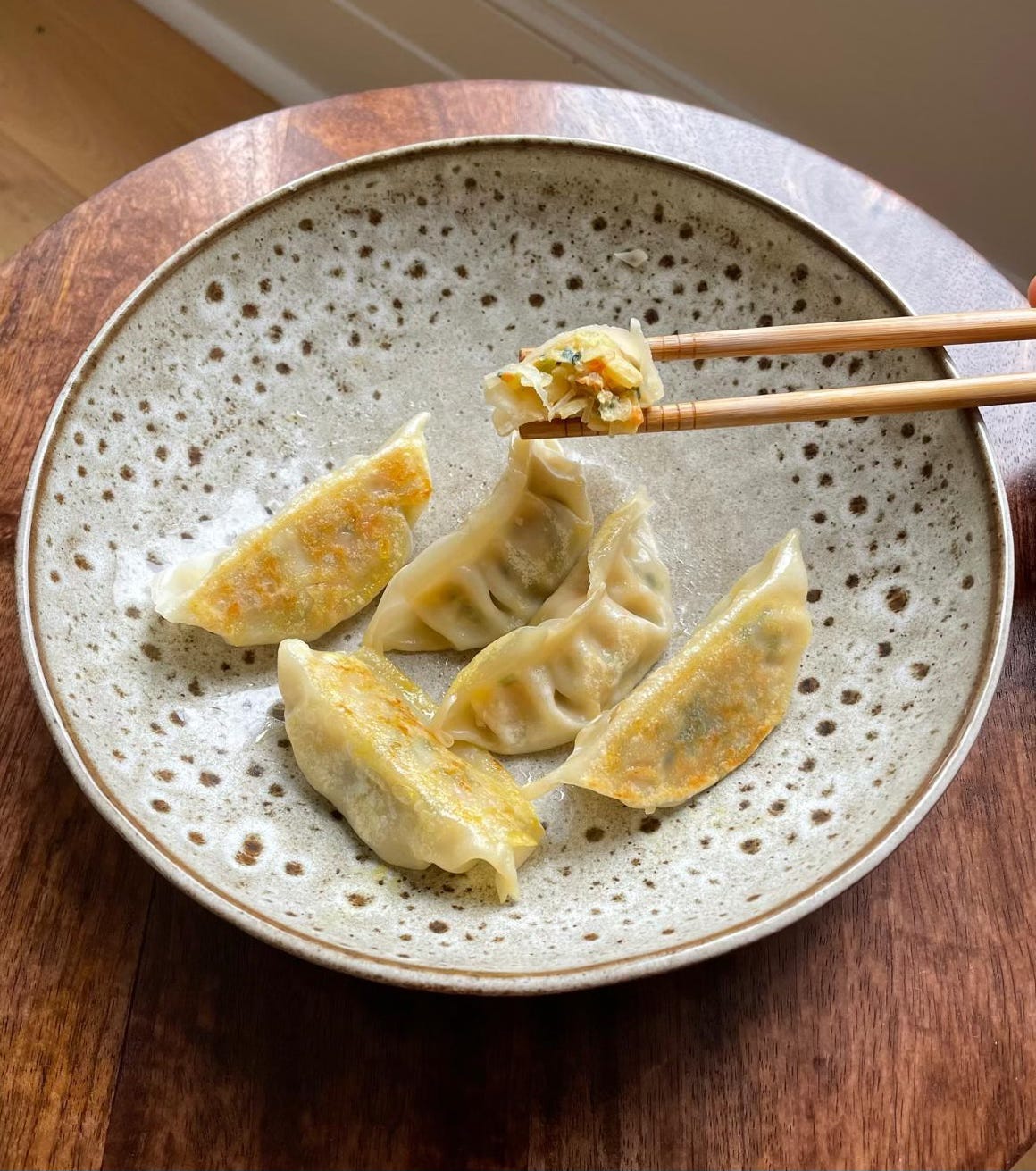
A Wednesday night, nearing 10, in my friend’s kitchen. Our socks are nubbed black on the knuckles of our toes, bodies burnt, from sliding across the floor in a contemporary dance class. She tips twelve frozen mandu into the frying pan, adding water from a jam jar to pan-steam them. Minutes later, each clutching a plate of half-moons, we sit to the high table in front of the window and chat: about friends, children, trips. The mandu have a creaminess, tofu and vegetables diced fine and knitted close. There’s also stability: I sink my teeth through the middle and the filling holds still in the half that waits between my chopsticks in the air. There’s a satisfaction in this, getting more than one mouthful from each dumpling.
The weekend after, mandu still on my mind, I cook six pieces and take them to the armchair in my living room. They're perfect this way; edges still crisping, hot in an open mouth, as Saturday afternoons lull or evening chats meander.
– –
Other dumplings I remember:
Squat, round baozi, dense with glass noodles and carrots, from a street stall in Taipei. Eaten from a metal Tupperware container in the corner of a subway station, out of the rain.
Vegetable momos on Temple Street; tender vegetables inside thick chewy casing, dipped in a spicy tomato chutney.
Shanghainese wontons, pleated close to the body and with tails that fan glamorous, floating in a misty salt broth.
Five boiled, five panfried, in that dumpling chain in Hong Kong. Skins mantis-green to mark their vegetarian contents, served on white paper plates.